My Meta Ads Creative Testing System for D2C (No Guesswork)
My weekly Meta Ads creative testing system for D2C: angles, hooks, kill rules, and scaling winners without burning budget.
Most brands test creatives like this: post 2–3 ads, wait a month, wonder why performance died.
I run it like a system. Same process every week, on every account. No guesswork, no “let’s try this random reel.”
Here’s the exact setup.
The mindset shift: test angles, not just ads
An angle is the reason someone buys. An ad is just one execution of it.
Examples of angles for a snack brand:
- “Guilt-free 4pm office hunger fix”
- “Kids lunchbox without junk”
- “Gym snack with real protein”
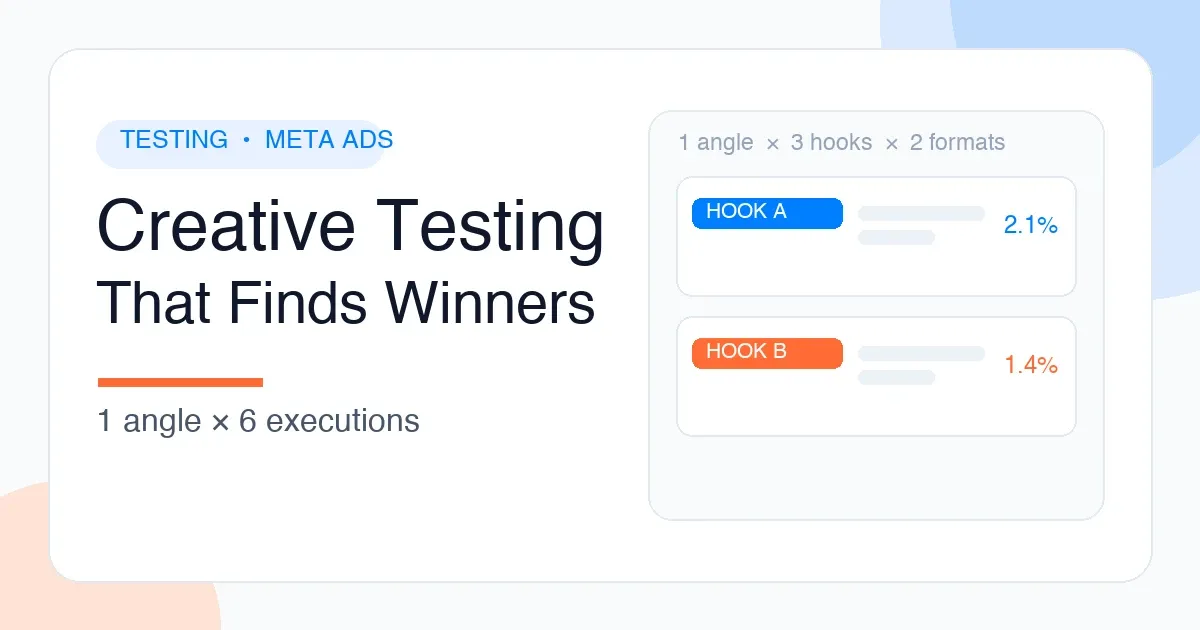
Each angle gets 3 hooks × 2 formats. That’s 6 creatives per angle. I test the angle first — if the angle is wrong, no edit will save it.
My weekly structure
One testing campaign. Broad audience (India, no narrow interests to start) + 1–2 stacked interest ad sets only if broad has no signal. Fixed daily budget per angle — usually ₹800–₹1,500/day in India.
One scaling CBO. Only proven winners move here. Nothing unproven ever enters scaling. This separation is the whole game — I explain why in my D2C playbook.
One retargeting campaign. Winners get recycled here with proof overlays (reviews, guarantees). Full setup: retargeting strategy.
Kill rules and scale rules (steal these)
No emotions. Just rules:
- Kill: No add-to-cart after 1.5x your target CPA in spend → kill it. No waiting, no hoping.
- Watch: Has add-to-carts but no purchase after 2x target CPA → give it 2 more days, max.
- Scale: 2+ purchases at or below target CPA → move to scaling CBO, keep the same post ID if possible.
- Iterate: Winner fatigues (frequency >2.5, CTR down 30%) → keep the angle and proof, shoot 3 new hooks.
These rules save more money than any targeting trick. They stop you from killing winners early and feeding losers too long.
What a test batch looks like
For one angle, I launch:
- 2 UGC videos (different hooks, same body)
- 1 founder/selfie video
- 2 statics (one bold claim, one review-wall)
- 1 carousel only if the product needs education
Same offer. Same landing page. Only the hook and format change. That way when something wins, I know why it won.
Confused about UGC vs studio? I broke it down with real numbers in UGC vs polished.
How I brief creators (copy this)
Bad briefs produce bad ads. My brief is one page:
- Angle in one line. Who is this for, what pain does it solve.
- 3 hooks written out word-for-word. Creators pick delivery, not messaging.
- Proof required: 1 number, 1 review screenshot, 1 demo clip. No proof = no launch.
- CTA — one action only. “Order today, COD available” beats three CTAs.
And the landing page must match the ad. If the ad says “sugar-free,” the page headline says “sugar-free” above the fold. Mismatch kills conversion faster than any algorithm change.
How much to test
Minimum 8–12 new concepts a month per brand. With creative fatigue at 10–21 days, anything less means you’ll always have gaps where tired ads burn money.
I do one batch a week. Small, consistent, never a month-long gap.
Takeaway
Creative testing isn’t talent. It’s a pipeline: one angle → six executions → clear kill rules → scale winners → new hooks. Run it weekly and you’ll never wake up to “ads suddenly stopped working” again.
I run this pipeline for clients every week — briefs, testing, scaling included. See the service or say hi.
FAQ
How many creatives should I test at once on Meta Ads?
3–6 per angle per week. Enough for signal, not so many that budgets split and nothing learns.
How long should I test a creative before killing it?
Until it spends 1.5x your target CPA. No add-to-cart by then → kill. 2+ purchases under target → scale.
How do I know if creative fatigue is happening?
Frequency above 2.5, CTR down 25–30% over 7–10 days, CPA climbing. Refresh the hook, keep the winning angle.
Want this done for your brand?
I run Meta Ads for D2C brands that want profitable growth — audit, tracking, creative testing, and scaling.